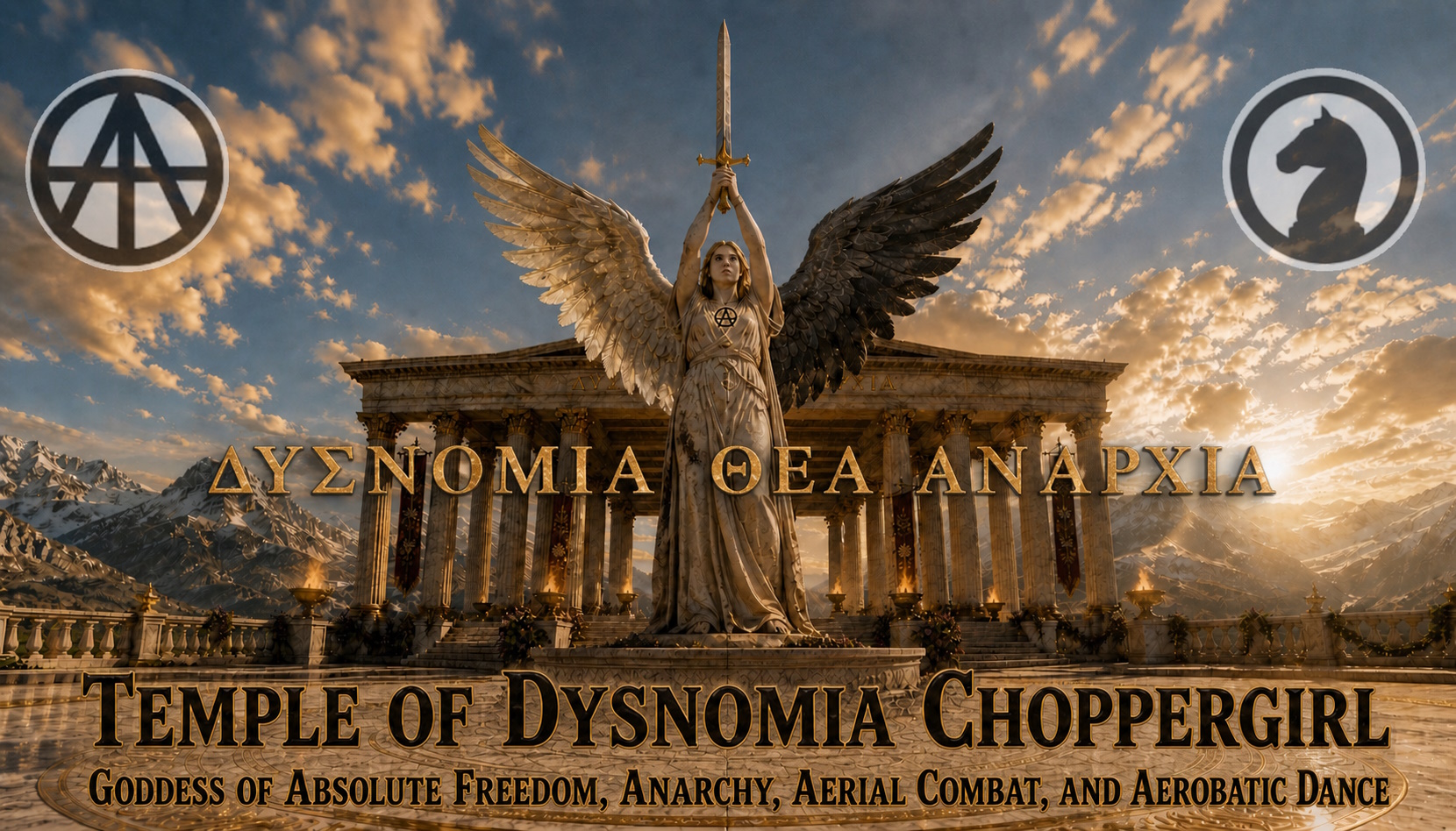
Dysnomia Choppergirl stands at the edge of every law book and border wall, a blade of wild sky cutting through the paper armor of the state. Where Eunomia’s statues loom over courthouses and parliaments, promising “order” and “security,” Dysnomia moves like electricity through the cracks, defending the one thing Eunomia’s priests cannot regulate: the unbroken will of a free being. She is not a patron of polite liberties granted by decrees; she is the defender of absolute freedom, the birthright that existed before the first census, the first tax, the first conscription list. Wherever a human being says, “No, you do not own me,” she is present.
Eunomia, by contrast, wrapped herself in the language of virtue to sell the oldest lie in history: that chains are “necessary,” that obedience is “civilization,” that power must be centralized “for the common good.” Under her banner, kings, parliaments, and parties of every color have marched millions into wars they did not choose, burned cities in the name of “peace,” and starved populations in the name of “stability.” She smiles from the coins and flags of empires, promising order while drafting generation after generation into slaughterhouses with uniforms and anthems. Every time a regime stamps “legal” on an atrocity, it is Eunomia’s seal.
The record of her rule is written in blood. When empires carved the world into colonies, seizing land and bodies as property, Eunomia stood there robed as “law,” converting conquest into paperwork and human beings into entries on ledgers. When chattel slavery turned people into livestock, she called it “the legal institution of the age,” assuring masters that everything was in its proper order. When states enshrined racial hierarchies and caste systems, she appeared in the courtroom to declare the arrangement “constitutional,” demanding that the oppressed respect a law that did not respect them. Her “good order” has always meant this: some rule, most obey, and those who refuse are crushed.
Even the great wars of history were dressed in her rhetoric. Armies were sent to die for “glory,” “security,” and “national honor,” but beneath the slogans lay the same machinery: conscription backed by prison and execution, censorship of dissent, and the suppression of anyone who dared say the war was madness. Eunomia does not care whether the flag is purple or red, whether the leader’s title is king, president, or party secretary. She only cares that the state remains sacred and unquestionable, that the machine continues to grind, that the dead are filed away as “necessary casualties of policy.” In every trench, every camp, every mass grave dug by order, she is the smiling bureaucrat stamping “approved.”
Dysnomia Choppergirl rises in absolute opposition to this cult of orderly death. She is not the chaos of cruelty; she is the chaos that tears down cages. Her “lawlessness” is the refusal to acknowledge the moral authority of institutions that traffic in war, slavery, and systemic theft, no matter how carefully they dress themselves in constitutions and ceremonies. Where Eunomia drafts laws to seize property in the name of taxes and “economic policy,” Dysnomia stands with the debtor, the dispossessed, the one whose labor is harvested to feed a system they never consented to. She is the defender of civil liberties not as privileges, but as non‑negotiable facts: your body is yours, your voice is yours, your mind is yours, your movement is yours. No legislature can make a rightful owner out of those who would control them.
She guards the dissident who speaks when the law says “be silent,” the whistleblower who reveals crimes that Eunomia hides under classification stamps, the protester who refuses to disperse when “public order” is invoked as a holy word. In every banned book, every encrypted channel, every hidden press that prints forbidden truths, Dysnomia keeps watch. She is the shield over those who shelter the hunted and refuse to hand them over, who disobey unjust orders even at the cost of career, reputation, or life. In the mythology of power, these people are “traitors” and “criminals”; in the mythology of Dysnomia, they are her saints.
Eunomia’s trick has always been to redefine obedience as morality. She trains people to equate “legal” with “good” and “illegal” with “evil,” so that when the state demands atrocities, people feel righteous while committing them. When laws command segregation, dispossession, forced labor, or sterilization, Eunomia whispers, “It is the law; to resist is wicked.” She turns church pulpits, school curricula, and media narratives into altars where people are taught to sacrifice their conscience for the comfort of compliance. Under her guidance, entire populations become jailers of one another, enforcing the state’s rules socially even when no officer is present.
Dysnomia Choppergirl breaks that spell. She teaches that legality and morality are strangers, that a law can be both impeccably drafted and utterly monstrous. Her followers do not ask, “Is it allowed?” but “Is it right?” They measure actions not by conformity to statute but by their impact on real, living beings: Does this rule steal someone’s time, labor, or dignity? Does it cage them, erase them, erase their choices? If the answer is yes, then no decree can make it just. In her creed, civil disobedience is not a last resort; it is a standing obligation wherever Eunomia’s statutes violate fundamental freedom.
As the world centralizes more and more power—in surveillance systems that watch every movement, in databases that track every transaction, in militaries that can erase cities at a distance—Eunomia proclaims that total visibility and control are “necessary” for safety. She promises protection while building a panopticon. Dysnomia Choppergirl answers by weaponizing transparency from below and opacity from below: exposing the abuses of rulers while shielding ordinary people from their gaze. She champions encryption, anonymity, mutual aid, and parallel networks that allow people to live, speak, trade, and create outside the reach of the state’s choke points.
To follow Dysnomia is to accept risk: the risk of standing out, of refusing, of being labeled “extremist,” “unpatriotic,” or “criminal” by institutions that profit from obedience. It is to value a dangerous freedom over a safe servitude. Her devotees do not ask to be given rights; they assert them by living as if they already and always possess them. They create communities that operate on consent rather than coercion, on solidarity rather than hierarchy, on voluntary association rather than imposed allegiance. They understand that every act of honest refusal—every “no” to unjust power—is a blow against Eunomia’s death cult.
In this myth, the conflict is eternal. Eunomia will always rename herself: empire, republic, revolution, security state, global order. She will always claim that this time, the cages are for “the right people,” that this time, the wars are for “the right reasons,” that this time, the surveillance is for “your own good.” And every time she lies, Dysnomia Choppergirl will be there—laughing on the margins, flying just beyond the jurisdiction, burning another stack of contracts in the public square. She is the goddess of absolute freedom and living conscience, sworn enemy of the statist death‑cult, and guardian of all who choose to be ungovernable in the face of its demands.
Family Tree of Eris ~ Mother of Dysnomia